


Announcing the publication of a special feature on Social Cohesion and Forced Displacement in the Journal of Conflict Resolution
Sarah Langlotz, Philip Verwimp, Patricia Justino and Tilman Brück, guest co-editors
Today we are happy to announce the publication of a selection of papers analysing social cohesion and forced displacement conflict contexts. Each paper is a significant contribution to our understanding of the complexity of forced displacement, and offers insights for policy making. These papers were presented at the 17th Annual Workshop of the Households in Conflict Network at the Georg-August University in Göttingen and have gone through a regular peer-review process in the Journal of Conflict Resolution. The special feature contains four contributions.
The first contribution, introducing the special feature, written by the guest-co-editors and Paul Michel, takes stock of the scientific literature on this wide-reaching topic and highlights key concepts, concerns, findings and limitations that confronts the research. Violent conflict and the dynamics of forced displacement have profound and heterogenous impacts on social cohesion outcomes within both host and origin communities. The authors argue that studying these heterogeneities across subpopulations with divergent migration experiences provides important insights to understand the relationship between conflict and social cohesion more generally.
The second contribution, co-authored by Juan F. Tellez and Laia Balcells, analyses the long-term consequences of forced displacement for social cohesion in Colombia, using household data and key stakeholder interviews. The study finds that a decade or more after displacement, victims experience substantial negative welfare deficits yet exhibit higher levels of social cohesion than their counterparts
The third contribution, co-authored by Isabel Ruiz and Carlos Vargas-Silva, focuses on the differences between those who stayed in their communities of origin during armed conflict in Burundi and those who were displaced internally and internationally and who returned home over time. The analysis suggests that internal returnees have significantly lower levels of trust, reconciliation, and community engagement compared to stayees.
And the fourth contribution, by Christian Ambrosius, traces the long shadow of immigration enforcement on violent crime in Mexico using migrants’ exposure to deportation threats at destination as a plausibly random source of variation to identify the causal effect of forced returns. Enforced return is associated with more homicides and a stronger presence of cartels in migrants’ municipalities of origin, as well as a higher sense of insecurity among the population and a higher probability of being assaulted. The paper reveals that higher deportation threats led to more returns, which in turn increased homicides and cartel expansion in Mexico, which may result in a vicious cycle of violence and eroding social cohesion.
All papers are available at the website of the Journal of Conflict Resolution
Latest News
EDT-Day – March 28th

The EDT STAT-ACTU is organizing its EDT-day on Friday March 28, 2025. It will take place in room “Salle des professeurs” on the 9th floor of the NO building (La Plaine, ULB). The program can be found below: Registration, free but compulsory, can be made on this page: Session 1 9.30am – 10am: Welcome (coffee and …
Continue reading "EDT-Day – March 28th"
Estelle Cantillon Organizes Belgian Environmental Economics Day (BEED 2025)
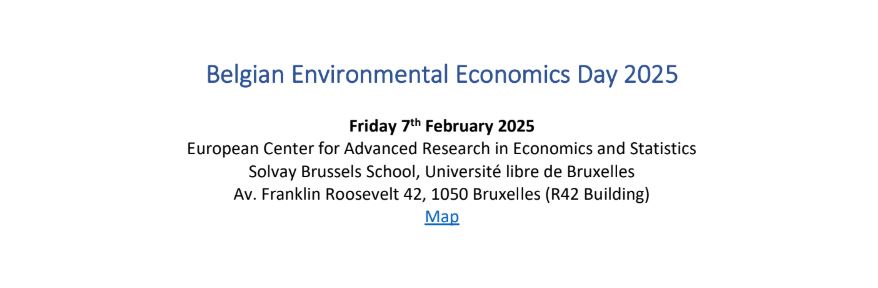
ECARES member Estelle Cantillon organized the Belgian Environmental Economics Day (BEED 2025), a key event for environmental economists in Belgium. The day brought together experts , and researchers to discuss pressing environmental issues through an economic lens. The event featured a series of presentations and discussions on various topics within environmental economics, providing a platform …
Continue reading "Estelle Cantillon Organizes Belgian Environmental Economics Day (BEED 2025)"
ECARES Welcomes Nobel Prize Laureate Jean Tirole for a Seminar
12 February 2025On February 6th, ECARES (Economics and Computing Research School) had the honor of welcoming Jean Tirole, the Nobel Prize-winning economist of 2014, for a prestigious seminar. Tirole, renowned for his groundbreaking work in industrial organization and market regulation, shared his insights on contemporary economic challenges. His presentation focused on his recent paper titled Engineering Commonality, …
Continue reading "ECARES Welcomes Nobel Prize Laureate Jean Tirole for a Seminar"
Visit us
ECARES - Solvay Brussels School of Economics and Management
Ave. F.D Roosevelt 42, 5th and 6th floors
1050 - Brussels - Belgium